
FMCG brands are turning to vending machines because they offer a sales channel that simultaneously bypasses the limitations of physical stores and e-commerce — operating 24/7, requiring no staff, and reaching customers exactly at the moment of purchase impulse. The growing importance of vending is clearly reflected in the numbers: the Polish market grew from PLN 800 million in 2018 to PLN 1.25 billion in 2023, while the number of vending machines increased from 20,000 to 27,000. This growth is not accidental — it reflects both the expansion of the vending market and changing customer expectations around product availability. The latest evidence that vending is no longer a niche comes from E.Wedel: in 2026, the brand launched its own “Wedlomats” at Złote Tarasy and the Chocolate Factory, recording sales above expectations within the first few months. Below, we explain how vending fits into an FMCG sales channel strategy and when it represents a genuine alternative versus simply an addition to the existing sales mix.
Vending is no longer associated exclusively with coffee and a chocolate bar in an office corridor. Vending machines have become fully-fledged points of sale — with their own product assortment, margins, and real-time data enabled by modern technologies built into each machine. For an FMCG brand, this is a new distribution channel in the literal sense: it does not replace a physical store or an online shop, but adds a third customer touchpoint and improves product availability where those two channels cannot reach. Modern sales channels, including vending, share one defining characteristic — they shift part of the responsibility for shopping convenience from people to machine fleet management systems. Shopping convenience is no longer just a slogan; it becomes a measurable outcome of the machine's design and location.
The confectionery segment best demonstrates the mechanism: impulse sales and spontaneous purchasing decisions operate differently from planned shopping in a store. A vending machine placed in a high-footfall location generates sales that an additional shelf in a store several hundred meters away would not — because the customer does not have to change their route to make a purchase. This represents a genuine change in the shopping experience: the product is available exactly when the desire to buy arises.
For FMCG brands, vending solves a specific problem: how to reach customers in high-traffic locations where opening another physical store is not economically viable. A sales strategy that ignores this channel also overlooks real customer experiences while on the move — and these experiences determine the performance of impulse-driven categories. Vending-based sales channels have a lower barrier to entry than opening a new store — there is no need to rent premises or hire staff, and the machine can be relocated if a location underperforms. A brand can build its own fleet or work with vending operators that run 24/7 retail networks across hundreds of locations and take responsibility for servicing and restocking. Established vending operators already have networks of high-traffic locations, shortening the time needed to test the channel from months to weeks — without them, a brand would have to build this expertise from scratch. Flexible cooperation with business partners makes it possible to test the channel without a major upfront investment before deciding to launch a fully self-managed sales channel. An owned sales channel provides full control over pricing and data, but it also requires an internal team to operate it — this is the approach E.Wedel has taken by building its own sales channel rather than outsourcing it entirely to an operator. Physical stores and an owned online shop do not disappear in this model — vending simply closes the gap that neither of them can cover.
In 2026, E.Wedel launched a pilot of its own branded vending machine, the “Wedlomat” — the company's first new distribution channel in decades, apart from the development of its own online store. This is no coincidence: the brand is returning to its roots. Jan Wedel was already installing his own vending machine in Warsaw in the 1920s, so innovative sales methods and new retail formats have been part of the brand's history from the very beginning.
The first Wedlomat was installed on level -1 of Złote Tarasy, next to the entrance to Warsaw Central Railway Station — one of the highest-traffic locations in the country. According to the company, the machine is generating sales above the original expectations at this location. The second machine operates at the E.Wedel Chocolate Factory Museum, while the next locations include the G City Targówek shopping center and selected industry events. Choosing high-traffic locations rather than random points is the Test & Learn approach in practice: a small-scale trial, hard sales data, and only then a decision on scaling to additional high-traffic locations. Without access to such high-traffic locations, even the best-designed vending machine will not generate results above expectations.
The history of vending in Poland is longer than the current smart vending boom might suggest. The vending machine introduced by Jan Wedel a century ago and today's contactless-payment Wedlomat are driven by the same business logic: direct sales without a salesperson, located where there is customer traffic. The technology has changed — from mechanical coin-operated systems to modern vending systems with telemetry and mobile payments — but the retail trends driving this model have remained the same: customers want to buy quickly, without queues, and without being limited by opening hours.
The value of the Polish vending market grew from PLN 800 million in 2018 to PLN 1.25 billion in 2023. Forecast for 2028: PLN 2 billion.
The vending market in Poland is growing at a pace that is difficult to ignore when planning sales channels, and its increasing importance is confirmed both by market data and by decisions made by brands such as E.Wedel. The growth of the vending market is evident in the numbers: its value increased from PLN 800 million in 2018 to PLN 1.25 billion in 2023, with a forecast of PLN 2 billion by 2028 — representing annual market value growth of more than ten percent. Such growth is difficult to find in traditional retail today, where margins are generally growing more slowly than in emerging channels. The number of vending machines increased from 20,000 to 27,000, with a target of 40,000 by 2028. This is also visible at the individual machine level: average annual revenue per machine reached PLN 46,296 in 2023, 15.7% more than in 2018. Market saturation remains low: there is one vending machine for every 950 residents in Poland, compared with one for every 23 residents in Japan. Globally, the vending machine market was worth USD 75 billion in 2025, with a forecast of USD 99.2 billion by 2033. This dynamic market growth is driven by cashless payments and the beverage segment, which accounts for nearly 45% of the market. The future of the vending industry is therefore not a question of “whether,” but of “how quickly.”
vending machines in Poland (2023) — target of 40,000 by 2028
average annual revenue per vending machine (2023, +15.7% vs. 2018)
vending machine per capita in Poland - in Japan 1 / 23
cashless transactions in Polish vending by 2028 (forecast)
An FMCG brand planning to enter the vending market needs to consciously position it among its other distribution channels rather than treating it as an add-on with no impact on the rest of the sales mix. Sales channels in retail are generally divided into direct and indirect channels — an owned vending machine is a direct distribution channel: the brand sells without an intermediary and controls pricing, product presentation, and customer data. This distinguishes it from sales through retail chains, where some of these decisions are controlled by the partner, and from models in which an independent retailer remains an important distribution channel.
In FMCG terminology, the traditional retail channel (GT — General Trade) refers to small, independent stores, while MT (Modern Trade) channels include retail chains, discount stores, and e-commerce. Vending does not fit entirely into any of these categories — it operates like a modern channel in terms of data and automation, but physically it can be present both in locations typical of MT (shopping centers, office buildings) and in places where neither of these channels previously had a presence.
Among the sales channels available to an FMCG brand today, alongside physical stores and its own online shop, a third category is emerging — a physical point of sale without staff. This is an important distinction from the online channel: a vending machine provides the physical product immediately, with no delivery time, while operating without the opening-hour limitations typical of traditional retail.
Sales channel integration only makes sense when data from vending machines flows into the same system as data from physical stores and the online shop. A multichannel strategy without shared sales analytics can turn the vending machine into an isolated island — the brand cannot determine whether it is cannibalizing sales at nearby physical stores or generating incremental revenue.
A vending sales channel strategy requires answers to three questions: which location, which product assortment, and which operating model — an owned fleet or cooperation with vending operators. A distribution strategy based on owned vending machines provides full control, but also full responsibility for servicing, restocking, and fiscalization — as of April 2026, vending machines in Poland must be equipped with certified fiscal modules. A good distribution strategy takes these requirements into account from day one rather than adding them as an afterthought, because adapting to regulatory changes during the scaling phase costs more than incorporating them into the machine design from the outset. A distribution strategy based exclusively on an owned fleet also differs in its entry cost from one based on vending operators — a good distribution strategy typically combines both models at different stages of scaling.
In practice, a good omnichannel strategy treats the vending machine as another source of customer data, not as a separate business. A brand that already invests in CRM and online-store analytics should integrate vending data into the same management system — otherwise, it loses vending's most valuable advantage: insight into what sells, where and when, and how this affects the customer experience across other channels.
Modern vending systems differ from those of a decade ago in one key aspect: telemetry. Remote monitoring of inventory levels, temperature, and machine failures allows operators to respond before a vending machine stops selling due to a lack of stock. Cashless payments — cards, BLIK, and QR codes — are now standard, with cashless transactions in Poland expected to reach 90% by 2028. In this model, sales automation means fewer service visits and a faster response to demand, while modern fleet management technologies allow a single person to monitor dozens of machines simultaneously.
Behind every vending machine a customer sees in a shopping center is an engineering process: mechanical design, electronics, firmware, and fleet management software. This is the area in which exa22 operates — we design and manufacture vending machines from concept to production readiness, combining R&D, electronics, and our own SMT/THT assembly line under one roof. FMCG brands that want to enter the vending market without building engineering capabilities from scratch can use Vendinity — vending solutions tailored to a specific brand and product assortment, manufactured under a white-label model. Proof that exa22 understands this market not only as a subcontractor is Anyvend — its own family of locker-style vending machines (AnyFlower, AnyBread, AnyLunch, and AnyCake variants), with deployment within 6–10 weeks of ordering. In addition to sales, these machines also support rentals, deposits, and order collection. This is no longer just retail infrastructure — it is infrastructure that supports both B2B sales and an operator-based business model. For brands and operators that do not want to replace their existing fleet but modernize it, exa22 also offers Clickash — a non-invasive retrofit for existing vending machines (compatible with FAS, Sandenvendo, Jofemar, Azkoyen, Ebs, among others) that adds a graphical menu display, cashless payments, and remote cloud management without replacing the mechanical system.
Beverage vending remains the largest market segment, while confectionery is the second largest. Both share one key characteristic: high turnover at a low unit price — exactly the product profile that works best in 24/7 unattended retail.
Below are brief explanations of the terms most commonly used when discussing FMCG sales strategies — useful to know before deciding where vending fits into the overall channel mix.
Vending machines and their underlying systems are as much an engineering project as a marketing decision—effective systems deliver telemetry, payments, and channel integration, and vending growth accelerates only when these three elements work in tandem. Vending is shifting from an adjunct sales channel to a standalone, strategically managed channel with its own economics for select FMCG brands. Entering this channel should begin with a Test & Learn pilot in 1–2 high-traffic locations; only positive outcomes in these high-footfall sites justify further scaling of the fleet, integrating data with core sales systems, and deciding between building in-house expertise or partnering with an operator experienced in the engineering side of the process.


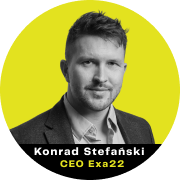
President of the Management Board at exa22 with over 10 years of experience in developing new mechatronic products and the author of two patents. An advocate of short iterations and rapid prototype validation — from R&D, electronics, and firmware to SMT/THT production and proprietary vending products.
Practical insights from embedded systems, cloud, and manufacturing. No spam.

